
Most brand teams check social media once or twice a day. A backlash can be decided in four hours. The time in between is the response gap, and it is where the money is lost.
What is the response gap?
It is the time from the first post that starts a backlash to the brand's first clear public reply. It has three parts:
- Detect: someone at the brand finds out.
- Decide: someone agrees what to say.
- Reply: the answer is posted where the complaint is.
Most teams only time step 3. Steps 1 and 2 are usually the slow ones.
Why speed matters more now
- Feeds reward anger. Angry posts get comments and shares, so they are shown to more people.
- News follows social media. Once a post is big enough, it becomes an article, and then the brand is reacting to a story someone else wrote.
- Customers expect fast answers. 40% expect a reply within an hour and 79% within a day (Sprout Social, 2020) [1].
- Markets react in a day. After the 2017 passenger video, United's shares fell about 4% early the next trading day, roughly $1 billion in value [3].
The money case: an Oxford study of corporate crises found that companies which communicated well ended the year about 20 points ahead in share value of those that didn't [5].
What our data shows
We tracked 78,803 comments about 23 brands and public figures from 24 August to 13 October 2026.
- Backlash is common. 12 of 23 had a negative spike in seven weeks.
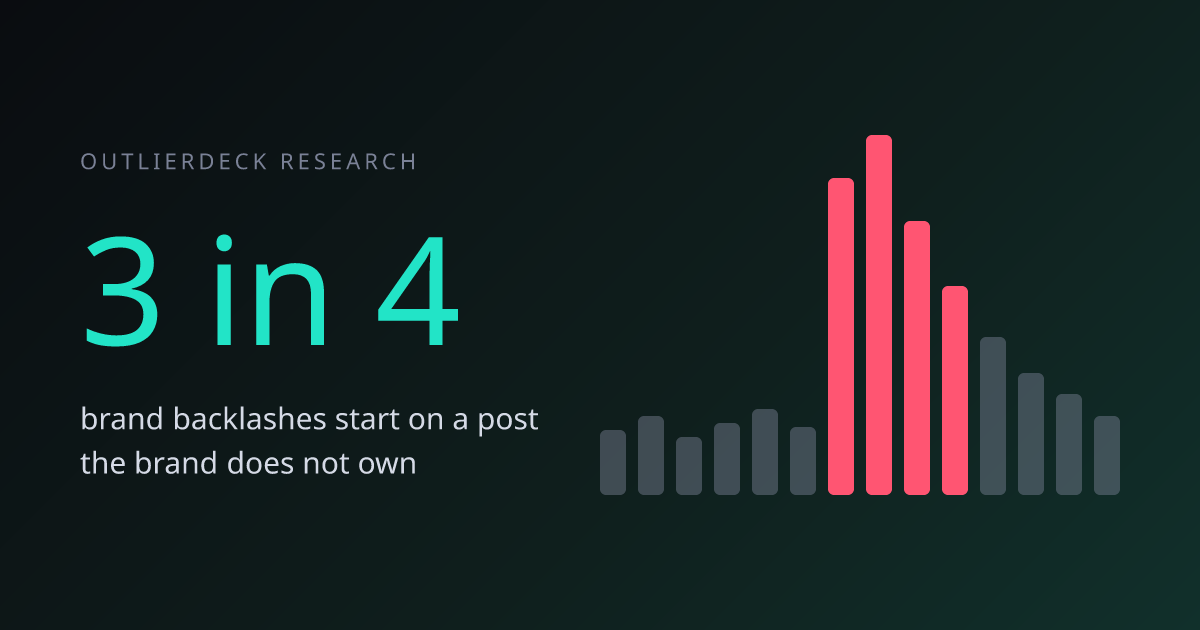
- It starts off your page. 74% of spikes came from a creator, customer or news post.
- It is usually one post. On almost half of spike days, one post carried at least half the negative comments.
- It moves in hours. When one creator complained about a spirits brand, half the first day's comments arrived in four hours.
Half of the first day's comments arrived in the four red hours.
6 real cases: fast vs. slow
1. Domino's (2009)
Two employees filmed themselves tampering with food. Domino's stayed quiet, hoping it would fade. Its quality score fell from +5 to −2.8 in one day, and took about four weeks to recover [7][8].
Lesson
Waiting for a post to die down is a decision, and usually the wrong one.
2. United Airlines (2017)
The first statement talked about having to "re-accommodate" passengers. The full apology only came on the third try [4].
Lesson
A fast, defensive reply is worse than a slightly slower honest one.
3. KFC UK (2018)
Hundreds of stores closed. Within a week, KFC ran an "FCK" empty-bucket ad with a plain apology [9]. Purchase intent held [10].
Lesson
A clear, human apology can stop a crisis before it reaches sales.
4. Peloton (2021)
Shares fell 11–16%. Three days later, Peloton's Ryan Reynolds ad showed the character alive and well. It went viral and the stock rose [11][12].
Lesson
A fast reply can take back the story, not just stop it.
5. Bud Light (2023)
The first statement avoided the issue. Bud Light lost its place as America's top beer, and AB InBev's US revenue fell 10.5% in the quarter [13][15]. Read the full case.
Lesson
A vague answer leaves the story to others.
6. A spirits brand (2026, our data)
The complaint was on the creator's own account, not the brand's. Negativity stayed high for three days. Read the full case.
Lesson
You can't reply to what you can't see.
The first-4-hours playbook
| When | Do this |
|---|---|
| Hour 0–1 | Find the source post. Read the top comments. |
| Hour 1–2 | Decide how serious it is. Post a short acknowledgement where the complaint is. |
| Hour 2–4 | Contact the person directly. Prepare a full answer. Brief staff. |
| Day 1 | Say what happened, what you are doing, and by when. |
| Day 2–7 | Track negativity. If it hasn't eased in 3 days, escalate. |
Are you ready? Would you know about a negative post within an hour, tonight? Is there one person who can approve a reply? Is a holding statement already written? If not, your gap is measured in days.