
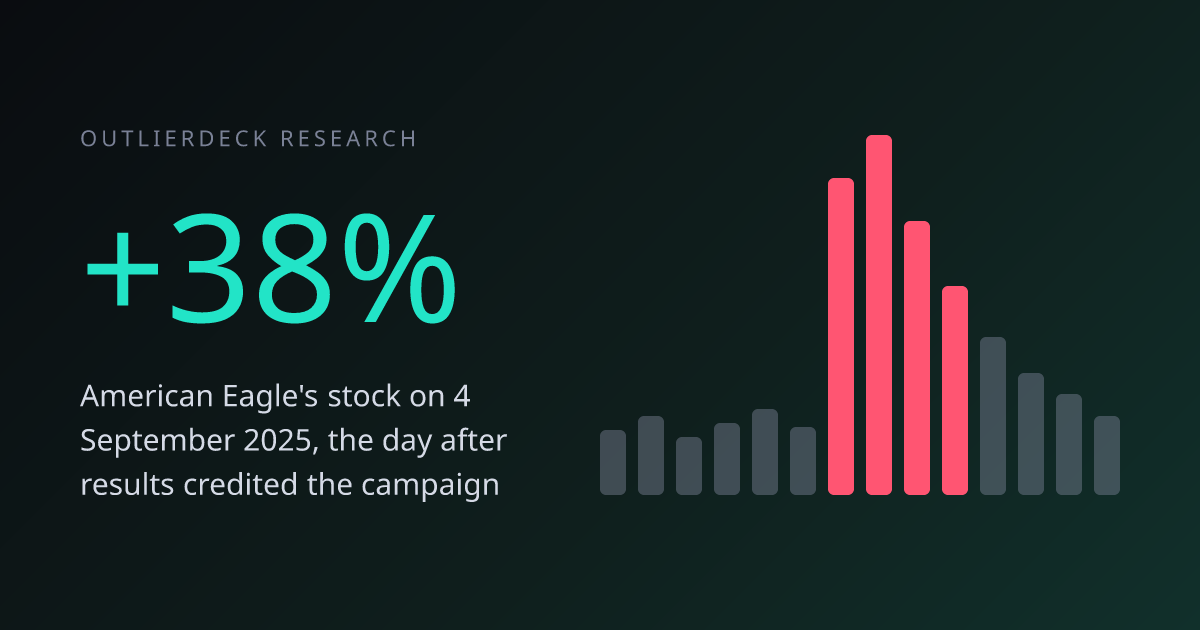
American Eagle's Sydney Sweeney campaign drew heavy criticism in mid-2025. The company kept it running, and the day after results that credited the campaign with record new-customer numbers, its stock closed up 38%. Negative noise is not the same as lost revenue.
This is the counter-example to Bud Light and Cracker Barrel. The difference is not how loud the backlash was. It is who was angry, and about what.
The spark
On 23 July 2025, American Eagle launched a denim campaign starring actor Sydney Sweeney, titled "Sydney Sweeney Has Great Jeans" (a pun on "genes"). Critics said the wording carried uncomfortable undertones, and the campaign became a culture-war talking point.
The spread
The campaign dominated feeds for weeks, with commentators on both sides and politicians up to President Trump weighing in. By the usual measures, such as the volume of posts and the share of negative comments, it looked like a crisis.
The response
American Eagle did not pull the campaign. On 1 August it posted one short statement saying the campaign "is and always was about the jeans", and kept it running.
On its results call a month later, its chief marketing officer said: "Sydney Sweeney has great jeans. It's not going anywhere." In April 2026 he called it the "most successful campaign in the history of" the brand.
The result
- Customers: at its Q2 2025 results on 3 September 2025, chief executive Jay Schottenstein said the campaign brought "record-breaking new customer acquisition". The company said customer counts were up more than 700,000 since the launch.
- Attention: the Sweeney campaign and a later Travis Kelce collaboration generated about 40 billion impressions, according to the company.
- Stock: the shares rose about 25% in after-hours trading on 3 September, then closed up 38% on 4 September, at $18.79.
- Sales: quarterly revenue still fell 1%, to $1.28 billion, and American Eagle brand comparable sales fell 3%. The quarter ended on 2 August, ten days after the launch. Brand sales turned slightly positive in the third and fourth quarters.
Why this went differently
- The anger was not about the product. Critics objected to a reading of the ad, not to the jeans, the price or the stores. Meanwhile, the company counted 700,000 more customers.
- The brand had a clear position and kept it. It issued one short statement and no reversal, so there was nothing new for critics to react to.
- Attention converted, slowly. Investors rewarded the new customers right away. Sales followed more gradually.
The lesson for monitoring
Counting negative comments is not enough. You need to know who is talking and what about. Are they your customers or bystanders? Are they complaining about the product, the price, or a culture-war angle?
The same volume of noise can mean "pull the campaign" or "double down". The difference is in the comment themes and the audience, not the headline count.
Five cases, one lesson
This is the last post in our series on how brand backlash plays out.
- The Response Gap: the first four hours decide what a backlash costs.
- One creator, one video: backlash often starts on a post the brand doesn't own.
- Bud Light: saying too little, too late, is the most expensive option.
- Cracker Barrel: backing down fast does not undo the damage.
- American Eagle: loud is not the same as costly, if you know who is talking.