
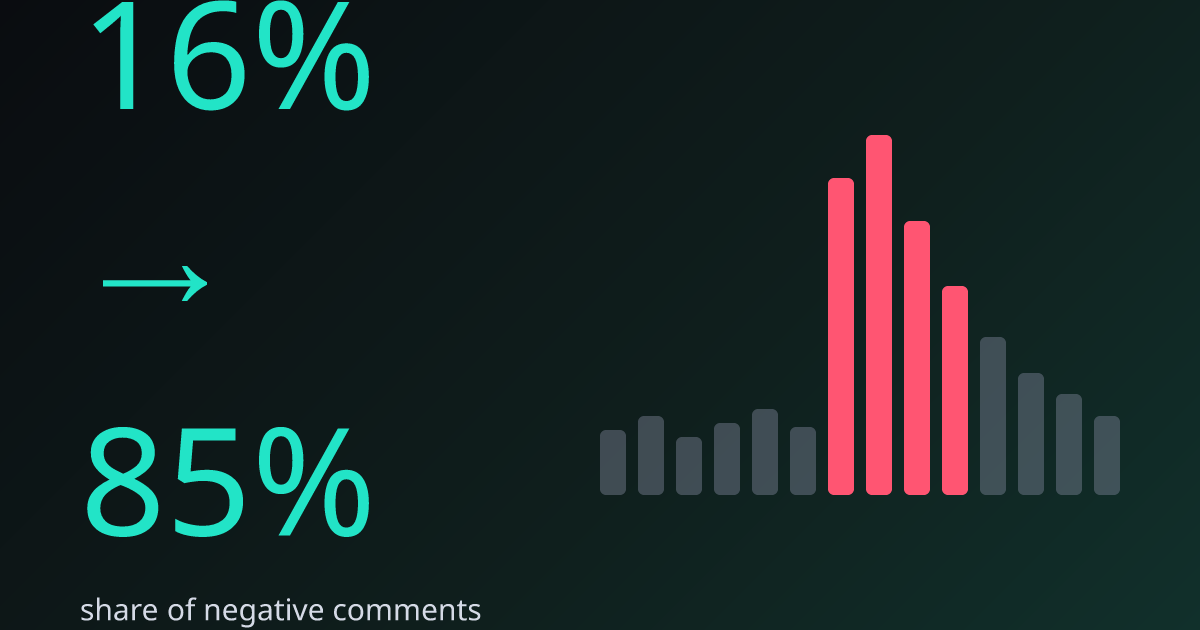
In the week before, 16% of comments about this spirits brand were negative. The day after one creator posted a complaint, it was 85%. No ad, no product recall and no news story were involved. It was one person, one video, posted on a Monday evening (North American time).
We have left the brand and the creator unnamed. The pattern matters more than the names. This is one of the cases behind our Response Gap research.
Before: an ordinary week
In the last week of August 2026, the brand's comments looked normal. Out of 125 comments that took a side, 20 were negative (16%). Most were about the product, events and parties.
The spark: a complaint about the agency, not the drink
On 31 August at 23:03 UTC, a creator with a loyal following posted a two-part video on Instagram, and eleven minutes later on TikTok.
The complaint was not about the product. It was about the brand's marketing agency. She said it had used her image without consent and without proper payment, and she called on other creators to speak up.
Our comment analysis found one theme in the replies: "the brand's agency used an influencer's image without consent or pay." Nobody was talking about the drink. Everybody was talking about how the brand treats creators.
The spread: half the first day in four hours
Hours counted from the first post, 31 Aug 23:00 UTC.
- Hour 1: 30 comments, 22 of them negative about the brand (73%).
- First 4 hours: 116 comments, 93 negative (80%).
- First 24 hours: about 220 comments. Half of them arrived in the first four hours.
- Reach: the TikTok version reached 128,800 views, 11,900 likes and 363 shares. The Instagram reel added about 40,800 views.
By the morning of 1 September, 99 of the 117 comments about the brand that day were negative: 85%.
The silence
Across the 265 comments we collected on the creator's posts, we found no reply from a brand account. The brand may have reached out privately. In public, the story was told entirely by the creator and her audience.
The recovery
Negativity stayed high for two more days (43% and 39%), then dropped back to 11% on 4 September. Eleven days later, the creator posted an update. We do not know what was agreed between them.
So the brand recovered. But for three days, the most-watched content about it was a video saying it mistreats creators. That came at a time when it relies on creators to sell.
What the brand could have done
- Watch the brand name, not just the brand page. The post was on the creator's account, so a team that only monitors its own page would have missed it.
- Treat agency problems as brand problems. The audience did not separate the agency from the brand, and the comments named the brand.
- Reply within four hours. A short public note ("We've seen this, we're looking into it today, and we'll make it right") lands while people are still reading.
- Close the loop in public. When it is resolved, say so where the complaint was made.
What it cost
We do not have this brand's sales figures, so we will not guess them. The measurable cost is attention: about 170,000 views of a video about how the brand treats people, during a period when its own posts were getting a fraction of that.